Quick answer
- Write down the question first. Identity, purity and amount are different questions and need different results.
- Choose a laboratory whose accreditation scope covers the method and the material, and confirm it with the laboratory.
- Agree the details before you send anything: sample requirements, method, reporting basis and unit, and any specification.
- Keep one record that links the lot, the vials sent, the laboratory's sample ID and the report.
- Compare on the same basis, and treat one result as evidence about the tested sample.
This is purchasing guidance, not a test method. The laboratory decides how a sample is handled and analysed.
Start with the question you need answered
- Identity: do the data support the compound named on the label? Mass spectrometry compares the measured mass with the expected mass. A matching mass alone does not prove the full structure, so ask what supporting data the laboratory reports.
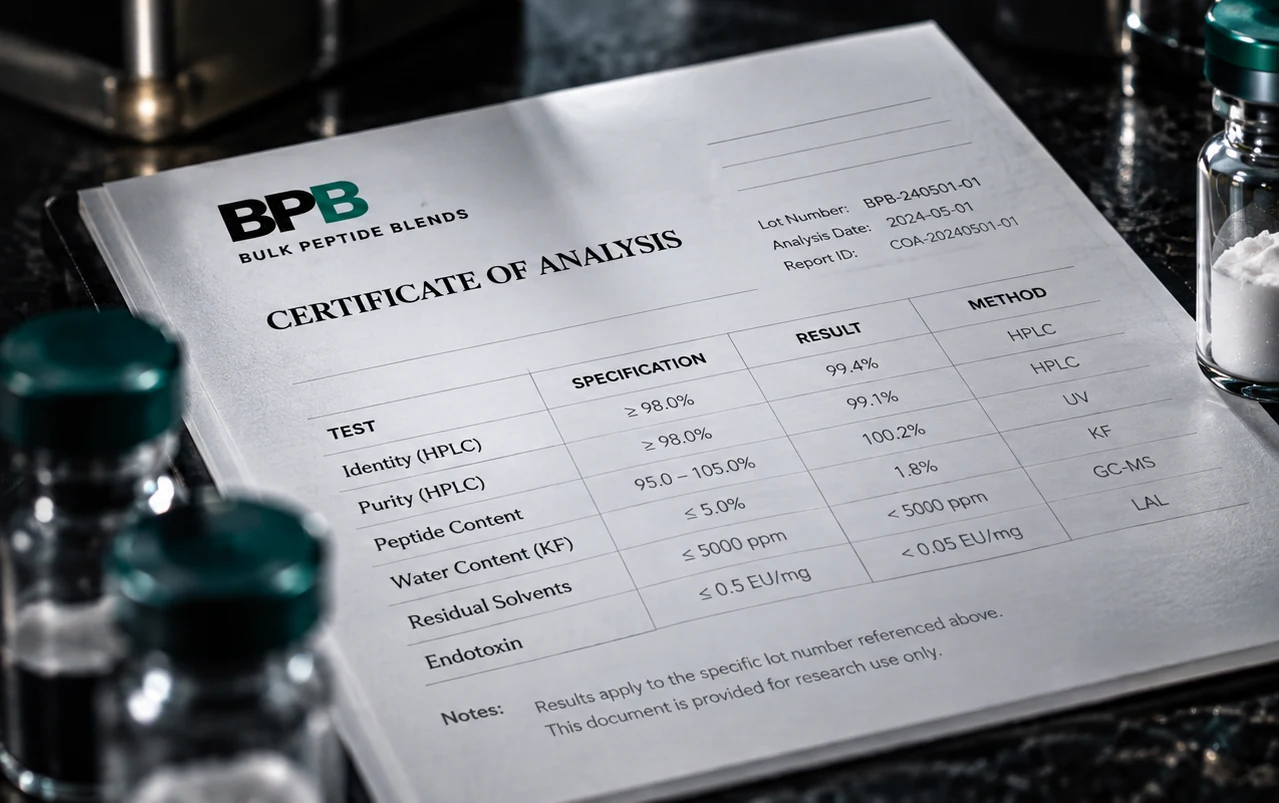
- Purity: what share of the detected signal is the main peak, under the stated HPLC method? A purity percentage does not tell you how much peptide is in the vial.
- Amount: how much peptide is in the vial, and on what basis — milligrams per vial or net peptide content? This is a separate result from purity.
- Anything else, such as endotoxin or heavy metals, is a separate test with its own method. Request it only if your question needs it. There is no single test panel that fits every question.
A narrow question keeps the request clear and the result easier to compare. Our guides to HPLC vs. mass spectrometry and reading a COA explain what each result means.
Choose a laboratory and check its scope
- Accreditation to ISO/IEC 17025 applies to the activities in a laboratory's scope of accreditation. That scope may not include every test the laboratory offers.
- Find the laboratory's accreditation body, then search that body's online directory for the laboratory. The ILAC FAQs describe this search.
- Check that the scope covers your method and the type of material. If you cannot tell, ask the laboratory before you order.
- Accreditation is evidence about the laboratory's competence for the listed tests. It does not decide whether a test answers your question.
Agree the details before you send anything
- Sample requirements: ask the laboratory how many vials it needs and how it wants them labeled, packed and shipped. Follow its instructions for your sample.
- Method and reporting basis: confirm the method for each question and how each result will be reported, including the unit.
- Specification and decision rule: if you want a pass or fail statement, agree the specification and how the result will be judged against it. ILAC guidance on decision rules (G8) says the rule is agreed with the customer before testing, unless the specification already sets it.
- The quote in writing: the tests, turnaround and price as the laboratory states them.
Keep a record that links the lot to the report
- Before anything is sent, record the supplier, product, declared amount and the lot number on each vial label.
- Note which vials went to the laboratory and which stayed with you, with their lot numbers.
- When the laboratory confirms receipt, write its sample ID next to your lot number.
- File the report with the supplier's certificate for the same lot and your receiving record.
The receiving record on the Supplier Due-Diligence page has a line for each lot you receive.
Compare results on the same basis
- Compare like with like: the same analyte, method, reporting basis and unit. Results on different bases cannot be compared directly.
- A measurement result is a value with an uncertainty. Where it affects a pass or fail against a limit, ask both laboratories how it was taken into account. ILAC guidance on measurement uncertainty (G17) covers when reports state it.
- Read identity, purity and amount as separate results, on both reports.
What one result can and cannot show
- A result describes the sample the laboratory tested. With good records, it is also evidence about the lot that sample came from.
- It is not proof about every vial, about other lots, or about material after further storage or transit.
- A report may state that uncertainty from sampling is not included in its stated uncertainty. Ask what the result covers if this is unclear.
- No single test is a safety or suitability guarantee for any use.
If your result and the supplier's certificate disagree
- Check the basics first: the same lot number, product and declared amount, and the same method, reporting basis and unit.
- Ask both laboratories for the method, specification and reporting basis behind each result, including any stated uncertainty.
- Send the facts to the supplier in writing and ask how it will investigate. Keep the remaining vials and all records for that lot until the question is settled.
- Do not average results from different methods, and do not assume the newer report is the right one.
Next step
Before you order, the Supplier Due-Diligence Checklist lists the documentation questions to ask each supplier. Comparing suppliers? You can ask about documentation when you request pricing.
General purchasing information for business buyers, not a test method and not a statement about any specific lot. Products are for research use only and are not for human or veterinary use.
For research and development use by qualified buyers. Products are not for human or veterinary use. This guide is general educational information, not a statement about any specific lot.