HPLC: how much of the sample is the target peptide
HPLC separates the components of a sample as it passes through a column. A detector records each component as a peak. Purity is usually reported as the main peak's share of the total detected peak area, expressed as a percentage.
That figure depends on the method: the column, the conditions and the detection wavelength. Components the detector does not see well are under-represented, so a purity result is always tied to its method.
Mass spectrometry: is it the right molecule
Mass spectrometry measures the mass of ionised molecules. For a peptide, the key question is whether the observed mass matches the expected molecular weight — which is why MS is the usual basis for an identity result.
Coupled with chromatography as LC-MS, it can also help characterise individual peaks, but a simple identity statement does not by itself quantify purity.
Why they are complementary
- HPLC can show a very clean peak that is the wrong compound; MS catches that.
- MS can confirm the right mass while impurities are present; HPLC shows them.
- Together they support two separate conclusions: this is the expected peptide, and this is how much of the detected material it represents.
Purity is not the same as content
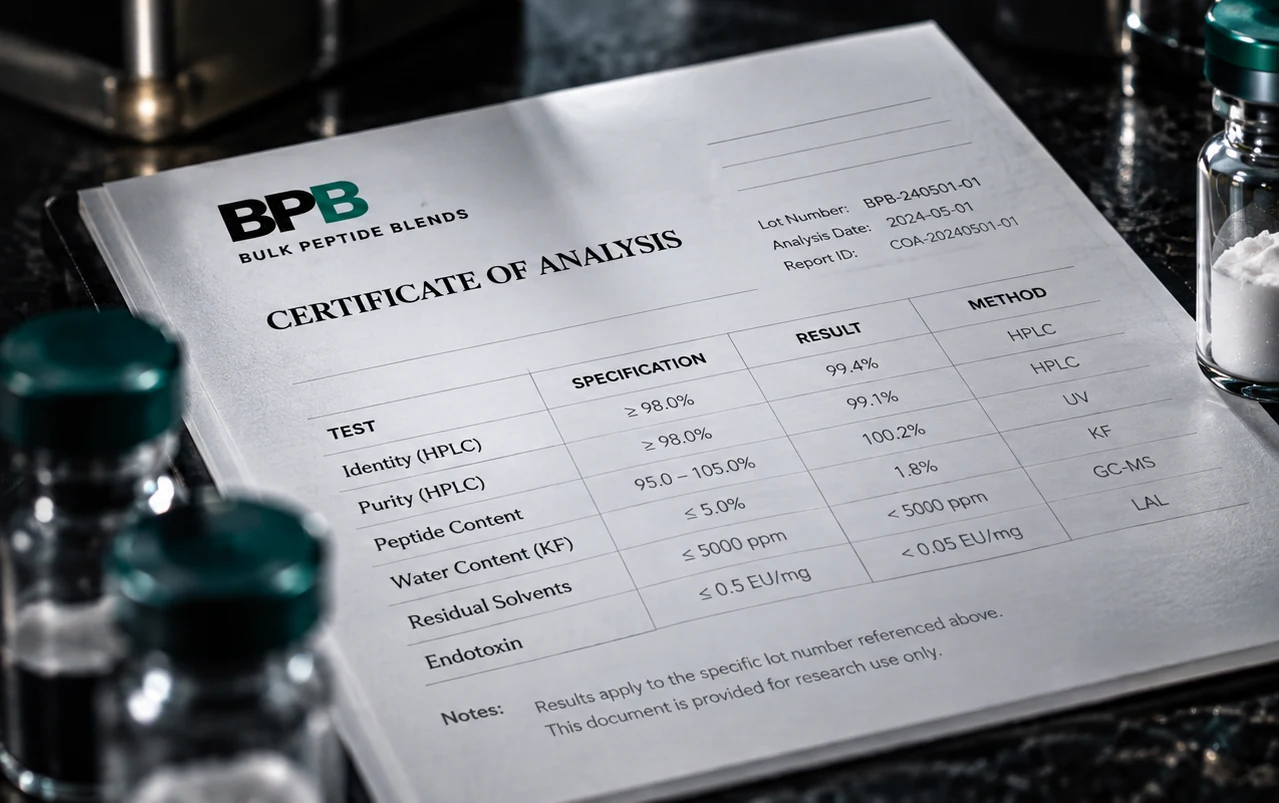
Purity describes composition; it does not say how many milligrams are in a vial. Peptide material can also contain water and counter-ions that HPLC purity does not account for. That is why some certificates report net content separately, usually by a quantitative HPLC method.
Reading results on a certificate
- Look for the method next to every result.
- Treat each result as applying to the tested sample and its lot only.
- Compare results with the stated specification where one is given.
For the document as a whole, see How to Read a Peptide COA. Representative lot results are published on our Quality page.
For research and development use by qualified buyers. Products are not for human or veterinary use. This guide is general educational information, not a statement about any specific lot.